
Aoc Kotlin个人解题记录(一)
Day 1 - Part 1
题目描述
The Elves have good news and bad news.
The good news is that they've discovered project management! This has given them the tools they need to prevent their usual Christmas emergency. For example, they now know that the North Pole decorations need to be finished soon so that other critical tasks can start on time.
The bad news is that they've realized they have a different emergency: according to their resource planning, none of them have any time left to decorate the North Pole!
To save Christmas, the Elves need you to finish decorating the North Pole by December 12th.
Collect stars by solving puzzles. Two puzzles will be made available on each day; the second puzzle is unlocked when you complete the first. Each puzzle grants one star. Good luck!
You arrive at the secret entrance to the North Pole base ready to start decorating. Unfortunately, the password seems to have been changed, so you can't get in. A document taped to the wall helpfully explains:
"Due to new security protocols, the password is locked in the safe below. Please see the attached document for the new combination."
The safe has a dial with only an arrow on it; around the dial are the numbers 0 through 99 in order. As you turn the dial, it makes a small click noise as it reaches each number.
The attached document (your puzzle input) contains a sequence of rotations, one per line, which tell you how to open the safe. A rotation starts with an L or R which indicates whether the rotation should be to the left (toward lower numbers) or to the right (toward higher numbers). Then, the rotation has a distance value which indicates how many clicks the dial should be rotated in that direction.
So, if the dial were pointing at 11, a rotation of R8 would cause the dial to point at 19. After that, a rotation of L19 would cause it to point at 0.
Because the dial is a circle, turning the dial left from 0 one click makes it point at 99. Similarly, turning the dial right from 99 one click makes it point at 0.
So, if the dial were pointing at 5, a rotation of L10 would cause it to point at 95. After that, a rotation of R5 could cause it to point at 0.
The dial starts by pointing at 50.
You could follow the instructions, but your recent required official North Pole secret entrance security training seminar taught you that the safe is actually a decoy. The actual password is the number of times the dial is left pointing at 0 after any rotation in the sequence.
For example, suppose the attached document contained the following rotations:
L68
L30
R48
L5
R60
L55
L1
L99
R14
L82
Following these rotations would cause the dial to move as follows:
- The dial starts by pointing at
50. - The dial is rotated
L68to point at82. - The dial is rotated
L30to point at52. - The dial is rotated
R48to point at_0_. - The dial is rotated
L5to point at95. - The dial is rotated
R60to point at55. - The dial is rotated
L55to point at_0_. - The dial is rotated
L1to point at99. - The dial is rotated
L99to point at_0_. - The dial is rotated
R14to point at14. - The dial is rotated
L82to point at32.
Because the dial points at 0 a total of three times during this process, the password in this example is _3_.
Analyze the rotations in your attached document. What's the actual password to open the door?
题目情景是一个0到99的圆形电话拨号转盘;L指的是往左转(递减数字),R指的是往右转(增加数字);0和99挨在一起,0 L1的结果就是99,反之99 R1的结果是0
转盘初始指向为50,题目要求的输出是:转到0的次数
解题代码
拨号转盘代码
拨号转盘类V1
class Day1 (
    val dialMinNum: Int = 0, // 拨号键盘最小数字
    val dialMaxNum: Int = 99, // 拨号键盘最大数字

    val dialStartPoint: Int = 50, // 拨号键盘起始指向
){
    private val range: Int = dialMaxNum - dialMinNum + 1

    var password: Int = 0
    // 当前指向的数字
    var dialCurrPoint: Int = dialStartPoint
    fun Point(): Int = dialCurrPoint

    private fun check() {
        dialCurrPoint = when(dialCurrPoint) {
            in dialMinNum..dialMaxNum -> dialCurrPoint
            else -> (dialCurrPoint + range) % range
        }

        if (dialCurrPoint == 0) password++
    }
    infix fun L(step: Int) {
        dialCurrPoint -= step
        check()
    }
    infix fun R(step: Int) {
        dialCurrPoint += step
        check()
    }
}

class Day1Test {
    @Test
    fun testDemo() {
        val obj = Day1()

        obj L 68
        obj L 30
        obj R 48
        obj L 5
        obj R 60
        obj L 55
        obj L 1
        obj L 99
        obj R 14
        obj L 82

        assertEquals(obj.password, 3)
    }
}- 本来想用
observable或vetoable监控并修改值的,但是后面发现值校正 也会触发observale,导致栈溢出,所以就换成朴素的手动修正了
V2
- 换上
setter函数
class Day1 (
    val dialMinNum: Int = 0, // 拨号键盘最小数字
    val dialMaxNum: Int = 99, // 拨号键盘最大数字

    val dialStartPoint: Int = 50, // 拨号键盘起始指向
){
    private val range: Int = dialMaxNum - dialMinNum + 1

    var password: Int = 0
    // 当前指向的数字
    var dialCurrPoint: Int = dialStartPoint
        set(value) {
            field = (value + range) % range
            // println("[修正]Pointed at $field")

            if (field == 0) password++
        }
    fun Point(): Int = dialCurrPoint
    infix fun L(step: Int) {
        dialCurrPoint -= step
        // check()
    }
    infix fun R(step: Int) {
        dialCurrPoint += step
        // check()
    }
HTTP客户端请求API获取题目输入
引入依赖:
dependencies {
    testImplementation(kotlin("test"))

    // Ktor HTTP Client
    implementation("io.ktor:ktor-client-core:2.3.12")
    implementation("io.ktor:ktor-client-cio:2.3.12")
    implementation("io.ktor:ktor-client-content-negotiation:2.3.12")
    implementation("io.ktor:ktor-serialization-kotlinx-json:2.3.12")
}参考示例:
// Common code
import io.ktor.client.*
import io.ktor.client.call.*
import io.ktor.client.request.*
import io.ktor.client.statement.*

suspend fun makeHttpRequest() {
    val client = HttpClient() // Ktor handles the correct engine internally
    val response: HttpResponse = client.get("https://api.example.com")
    println(response.body<String>())
    client.close()
}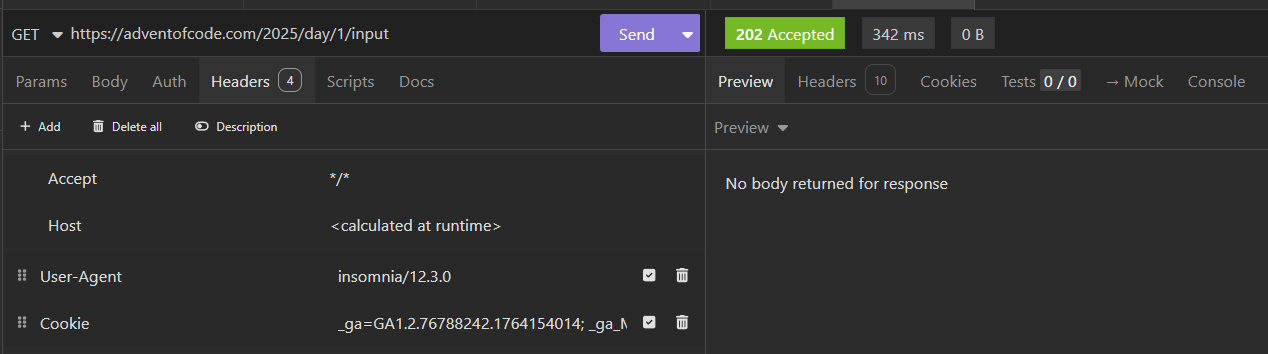
暂时不清楚要怎么获取输入
解析题目文本
- 直接拓展在题目类上
- 使用
useLines逐行解析文本,避免一次性加载文本到内存中
package org.example.Day1

import java.io.File

class Day1 (
    val dialMinNum: Int = 0, // 拨号键盘最小数字
    val dialMaxNum: Int = 99, // 拨号键盘最大数字

    val dialStartPoint: Int = 50, // 拨号键盘起始指向
){
	// ...

    // 从字符串中格式化解析出来拨号动作
    fun resolveOneLine(line: String?) {
        val rotation = line?.get(0) ?: return
        val step = line.substring(1).toIntOrNull()?: return

        when(rotation) {
            'L' -> L(step)
            'R' -> R(step)
            else -> return
        }
    }
    fun resolveLines(lines: Sequence<String>) {
        for (line in lines) {
            resolveOneLine(line)
        }
    }
    infix fun readFile(fileName: String) {
        File(fileName).useLines {
            lines -> resolveLines(lines)
        }
    }
}- 工作目录为项目根目录
- 使用
Path(String).toAbsolutePath在发生FileNotFoundException时打印完整路径进行debug
@Test
fun testReadFile() {
    // 工作目录为: F:\KotlinProjects\AoC2025
    // 或<PROJECT_ROOT_PATH>
    val fileName = "src/main/resources/puzzles/2025/day1.txt"
    val day1 = Day1()

    try {
        day1 readFile fileName
    } catch (e: FileNotFoundException) {
        // 解析并打印完整路径
        println("File not found: ${Path(fileName).toAbsolutePath()}")
    }

    println("password: ${day1.password}")
}
Day 1 - Part 2
题目描述
You're sure that's the right password, but the door won't open. You knock, but nobody answers. You build a snowman while you think.
As you're rolling the snowballs for your snowman, you find another security document that must have fallen into the snow:
"Due to newer security protocols, please use password method 0x434C49434B until further notice."
You remember from the training seminar that "method 0x434C49434B" means you're actually supposed to count the number of times any click causes the dial to point at 0, regardless of whether it happens during a rotation or at the end of one.
Following the same rotations as in the above example, the dial points at zero a few extra times during its rotations:
- The dial starts by pointing at
50. - The dial is rotated
L68to point at82; during this rotation, it points at0once. - The dial is rotated
L30to point at52. - The dial is rotated
R48to point at_0_. - The dial is rotated
L5to point at95. - The dial is rotated
R60to point at55; during this rotation, it points at0once. - The dial is rotated
L55to point at_0_. - The dial is rotated
L1to point at99. - The dial is rotated
L99to point at_0_. - The dial is rotated
R14to point at14. - The dial is rotated
L82to point at32; during this rotation, it points at0once.
In this example, the dial points at 0 three times at the end of a rotation, plus three more times during a rotation. So, in this example, the new password would be _6_.
Be careful: if the dial were pointing at 50, a single rotation like R1000 would cause the dial to point at 0 ten times before returning back to 50!
Using password method 0x434C49434B, what is the password to open the door?
现在不是刚好指到0才算数,是过程中只要有一刻指到就算
解题代码
题目本类
- 给Part1的类加个
open关键字,允许Part2类去继承 - 尝试写环形列表,但是不好处理步数很大的情况,于是退回到纯计算
P2V1
override var dialCurrPoint: Int = dialStartPoint
    set(value) {
        val lastField = field
        field = if ((value % range) >= 0) value % range else range + (value % range)

        // println("$lastField -> [raw]$value |[mod]$field by ${(value - lastField).absoluteValue}")
        password += if (value <= 0 && lastField != 0) {
            (value.absoluteValue + range) / range
        } else value / range
    }
这里实际上也处理不了步数很小的情况
没有用上的环形迭代器,因为不好处理多倍跨越
package org.example.Day1

// 自制可选方向的环形迭代列表
enum class CycleDirection {
    LEFT, RIGHT
}

operator fun IntRange.plus(other: IntRange): IntRange {
    return IntRange(this.first + other.first, this.last + other.last)
}
fun Int.circular(
    min: Int = 0, curr: Int = 50, target: Int = 99, max: Int = 99,
    stepLength: Int = 1, direction: CycleDirection = CycleDirection.RIGHT
): Iterable<Int> {
    return when (direction) {
        CycleDirection.LEFT -> {
            if (curr < target) (curr downTo min step stepLength) + (max downTo target step stepLength)
            else curr downTo target step stepLength
        }
        CycleDirection.RIGHT -> {
            if (curr > target) (curr..max step stepLength) + (min..target step stepLength)
            else curr..target step stepLength
        }
    }
}

infix fun Int.toLeftCircular(target: Int): Iterable<Int> {
    return this.circular(min = 0, curr = this, target = target, max = 99, direction = CycleDirection.LEFT)
}
infix fun Int.toRightCircular(target: Int): Iterable<Int> {
    return this.circular(min = 0, curr = this, target = target, max = 99, direction = CycleDirection.RIGHT)
}
P2 Gemini
- 鏖战三小时不得不请G老师出山
- G老师针对终点为0的情况做了优化,稍微偏转一下指针以计算跨越0的次数
override var dialCurrPoint: Int = dialStartPoint
    set(value) {
        val start = field
        val end = value

        // 核心逻辑:计算经过了多少次 range 的倍数(包括终点)
        // 我们判断在 [min(start, end), max(start, end)] 区间内有多少个 0
        // 但要排除掉起点(因为起点在上一回合已经算过了)

        val delta = end - start
        val count = if (delta > 0) {
            // 顺时针旋转:计算 (start, end] 间的 0 点
            Math.floorDiv(end.toLong(), range.toLong()) - Math.floorDiv(start.toLong(), range.toLong())
        } else {
            // 逆时针旋转:计算 [end, start) 间的 0 点
            // 注意这里:为了包含 end 且排除 start,我们稍微反转一下
            Math.floorDiv(start.toLong() - 1, range.toLong()) - Math.floorDiv(end.toLong() - 1, range.toLong())
        }

        password += count.absoluteValue.toInt()
        field = value

    }